

I met up with old friends to follow the Plagues, Pestilence and Pathology self-guided walk published by the City of London.
We decided to meet up at the ‘end’ of the walk at Guy.s Hospital. Whilst waiting I was struck by the hospital’s coat of arms. I thought the golden heads were clowns – but they’re leopards apparently:
- Sable, on a chevron or, between three leopards’ heads argent, each crowned with an Eastern crown of the second, as many fleurs-de-lis azure. Crest — On a wreath of the colours, a woman sitting accompanied with three children proper, habited azure, being the emblem of Charity. Supporters — On either side, an angel proper, habited argent, the hair and wings or, each holding a book proper, the clasps gold.
After a visit to the 1780s Guy’s chapel, England’s only surviving 18th-century hospital chapel; we crossed the courtyard to visit the Science Gallery and it’s current exhibition Quantum Untangled.
Through interactive artworks, immersive sculptural installations and the words of physicists, philosophers and poets, Science Gallery London’s new exhibition Quantum Untangled fuses art, science and extraordinary interdisciplinary research together to consider big quantum questions and reveal the power quantum possesses to transform our futures.
I felt it emphasised the artworks over explanations – but that’s probably about right for a general audience getting an introduction and there were lots of students keen to engage the audience.
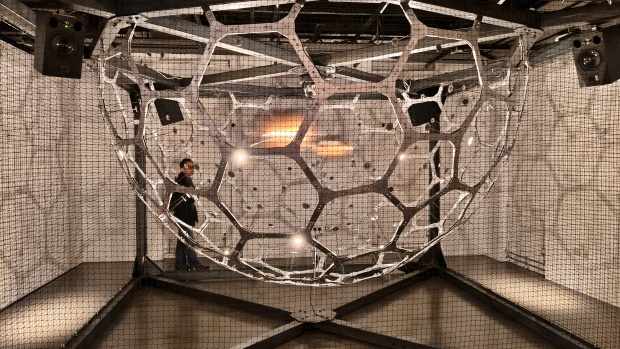
The installation below is:
In the moments after two black holes merge, a phase known as ‘ringdown,’ gravitational waves are emitted as the newly-born black hole vibrates like a struck bell. Drawing on this comparison, artist Conrad Shawcross reimagines gravitational waves as sound waves in this kinetic artwork…
Once set in motion, the bell’s trajectory is tracked by steel rods attached to the hemispherical cage, evoking the spiralling motion of gravitational waves.
Leaving the exhibition we walked over London Bridge and along Cannon Street to the official start of the walk at the City Information Centre. Between St Paul’s and the river there are a maze of streets that have mainly survived bombs and redevelopment. Passing the original site of the Royal College of Physicians, we ‘discovered’ St Andrew by the Wardrobe church.
The church acquired its distinctive name in 1361 when King Edward III moved the Royal Wardrobe—the storehouse for ceremonial robes and armor—to the nearby vicinity. The church’s most famous connection is to William Shakespeare, who was a resident of the parish for roughly 15 years while working at the nearby Blackfriars Theatre.
The church has twice been brought to the brink of total destruction. It was first razed during the Great Fire of London, after which it was rebuilt by Wren; notably, it was the last of his City churches to be completed. In December 1940, the building was again gutted by incendiary bombs, leaving only the tower and exterior walls. Following its mid-century restoration, the church underwent a significant renovation completed in 2023. This project made it London’s first Grade I listed carbon-neutral church through the installation of air-source heat pumps and improved insulation. It now serves a unique dual role as an Anglican parish and the London headquarters for the Coptic Orthodox Church.
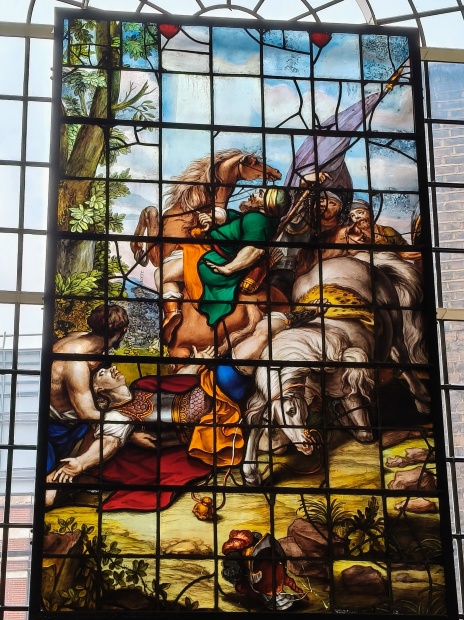
The walk then proceeded past three grand livery halls – Apothecaries’, Stationers’ and Cutlers’ – onto Newgate Street and the Old Bailey. Skirting St Sepulchre Without Newgate we reached St Bartholomew’s Hospital. Passing through the gate with the rare public statue of Henry VIII we visited St Bartholomew the Less, the only parish church physically situated within a hospital.
Then passing the Wallace memorial, we reached the fabulous St Bartholomew the Great, the oldest surviving parish church in London.
The site was established during Henry I reign. Rahere, the man who established the church and hospital, went on pilgrimage to Rome and became ill. As he lay delirious, he prayed for his life vowing that, if he survived, he would set up a hospital for the poor in London. The church has a unique look, as the medieval Norman styling remains. The church has a rich history from surviving the dissolution of monasteries during the Tudor period, to being the home of the Black Friars in the reign of Mary I.
It survived the Great Fire of 1666, the bombs dropped in Zeppelin raids in World War I and the Blitz in World War II. The church was briefly abandoned but was restored in the 19th century.
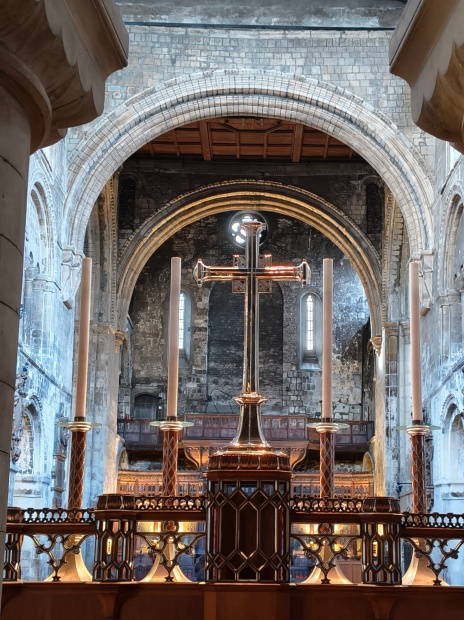
After exploring the church, we walked through Smithfield and Clerkenwell to St John’s Gate and the Museum of the Order of St John.
The self-guided walk continues from St John’s Gate to the Charterhouse, Barber-Surgeons’ Hall and then crosses the Millenium Bridge to Southwark. But, having previously visited the museum, of St John, we ran out of steam and headed off to a Malaysian cafe near the Barbican Centre, Jiak 吃 , for a late lunch.